This is the second book in the "Death Trilogy" that features on this list; the others being A Death in the Family, and Death Comes for the Archbishop. I guess the novelization of Death to Smoochy just didn't make the cut.
I didn't know anything about this book when I started reading it, but shouldn't have been surprised that I enjoyed it. First off, it's on this list, and I've enjoyed most of the books on this list. Secondly, it's set in inter-war Europe, and I don't think there has been an inter-war European book I haven't enjoyed (remember, Gravity's Rainbow was during the war).
Follow my quest to read every book from Time Magazine's 100 All Time Novels.
Showing posts with label review. Show all posts
Monday, June 6, 2016
Monday, April 11, 2016
#82 - "Invisible Man" by Ralph Ellison
I finished my 82nd book, Invisible Man, in January. Ralph Ellison’s 1952 work is a novel of racial tension in Interwar America; not an uncommon theme on this list, and one I was expecting to be similar (which isn’t a bad thing), to Native Son.
Invisible Man is the story of an unnamed narrator’s journey from the South in an unspecified time, to New York, where he works for social justice and racial equality. Starting as a gifted but underprivileged orator, he is able to obtain a scholarship through a humiliating “battle royale,” where he defeats other young, blindfolded, black men, fighting for a sac of fake gold pieces.
Thursday, March 24, 2016
#81 - "Pale Fire" by Vladimir Nabokov
My exodous from blogging about these books is over. I continue to find it difficult to not just write this blog, but also to read the books from the List. Since my last post, I have read this one and only one other, Invisible Man. Very little progress to say the least, but I am continuing, and just picked up The Death of the Heart by Elizabeth Bowen.
After taking such a long break from writing here, it became more and more difficult to start up again. The good news is I've decided I needn't dwell on why I haven't been reading or writing, but instead just to start up again, and continue on.
WIth out further ado, my review of Pale Fire, which I finished reading in September.
After taking such a long break from writing here, it became more and more difficult to start up again. The good news is I've decided I needn't dwell on why I haven't been reading or writing, but instead just to start up again, and continue on.
WIth out further ado, my review of Pale Fire, which I finished reading in September.
Monday, June 22, 2015
#80 - "Gravity's Rainbow" by Thomas Pynchon
From dictionary.com:
adjective
Time's Richard Lacayo starts off his summary on why this one is on the list with "no, it is not unreadable." He then describes the plot as "unsummarizable," which as far as I know isn't a word.
[uhn-ree-duh-buh l]
1.
2.
not interesting to read; dull; tedious; an unreadable treatise.
3.
extraordinarily difficult to read or comprehend; obscure;incomprehensible:
an unreadable dream; an unreadable expression.
Wednesday, April 29, 2015
#79 - "A Handful of Dust" by Evelyn Waugh
I finished Evelyn Waugh's second book from the list, A Handful of Dust about two weeks ago, while still in Thailand. It was one I had been looking forward to for quite some time, having enjoyed his other list book, Brideshead Revisited, when I read it five years ago, at #2.
Written in 1934, A Handful of Dust follows Tony and Brenda Last, as they live out their happy, but mundane life at Hetton Abbey, Tony's beloved estate in the English countryside. The couple has one son, and lives very comfortably on their inherited wealth, sticking to old fashioned, aristocratic social norms.
Soon, life becomes too routine for Brenda and while at a party she becomes interested in John Beaver, a rather common man, who finds himself at these parties more as a novelty than a guest. Brenda is pulled toward him, finding him exciting and different, when in reality he is merely ordinary, if not mediocre. But she continues a relationship with him, even going so far as to rent a flat in London, for weekday rendezvous.
Friday, February 20, 2015
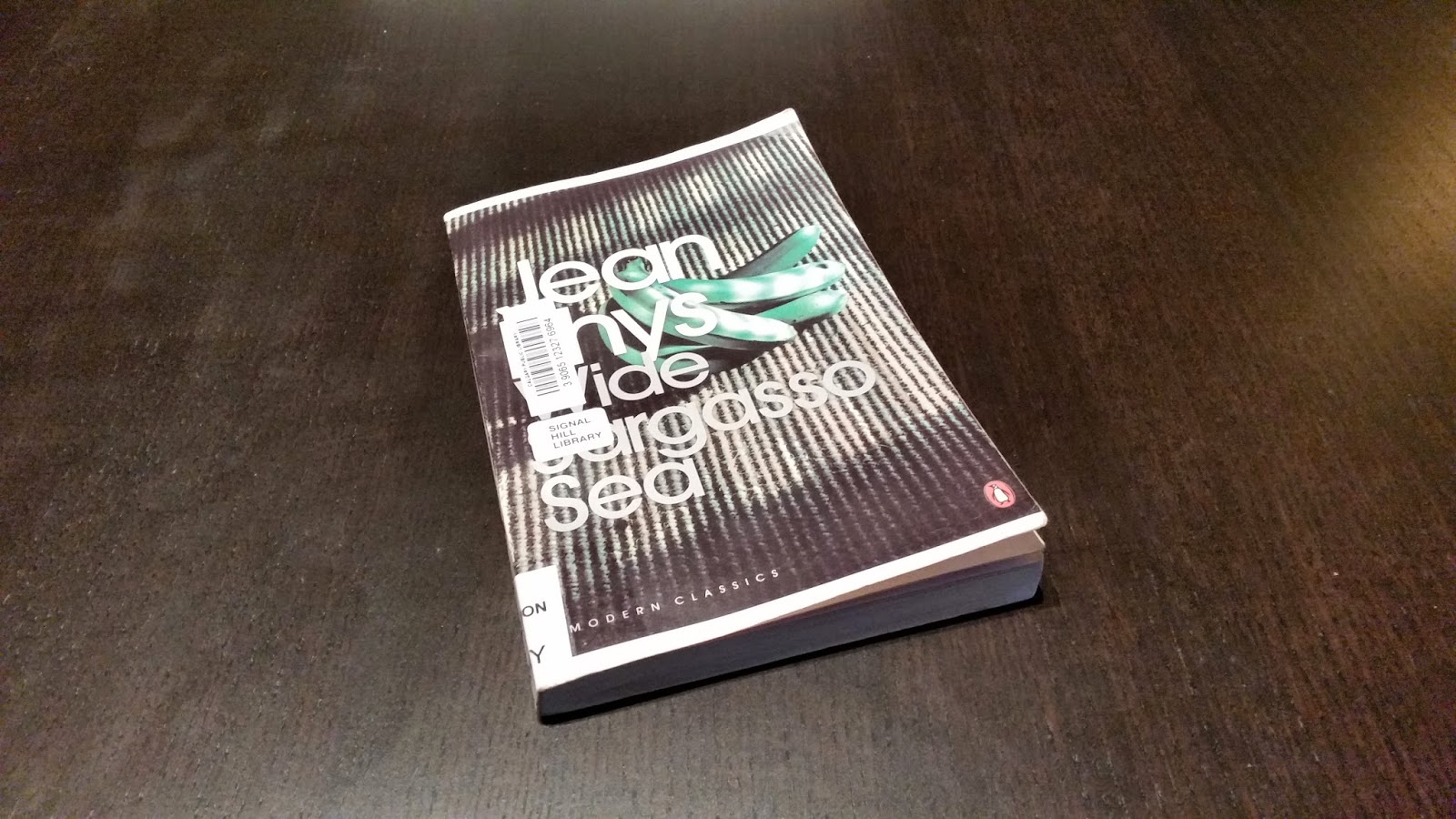
#78 - "Wide Sargasso Sea" by Jean Rhys
After reading three consecutive 500+ page books, I enjoyed a well-deserved break, with the 156 page Wide Sargasso Sea by Jean Rhys. Not only was it short, but also very readable, and I suppose I enjoyed it somewhat.
Written in 1966, the book is billed as a prequel to Charlotte Bronte's Jane Eyre. And I'd guess it is the first ever prequel, coming out over 30 years before "Star Wars Episode 1" created one of my least favorite cinematic terms/trends. For me though, it was just a book, as I haven't read Jane Eyre, nor do I know anything about the plot or characters. Now I just have to determine who in Wide Sargasso Sea is the equivalent of Jar Jar Binks.
Thursday, January 22, 2015
#77 - "The Golden Notebook" by Doris Lessing
What can I say about #77, The Golden Notebook? It took me nearly three months to read it, and at times I'm not even sure what I read. It's a long, complicated, and often very frustrating book. It is often described as a "feminist novel," but I wouldn't say that at all. In fact, I'm not even sure what that's supposed to mean. I would describe it is an emotional novel, exploring the deep, personal thoughts of its protagonist. I'd also say that despite moments of brilliance, I don't think I really enjoyed reading it.
Anna Wulf, a writer, records her life in four coloured notebooks, black, blue, red, and yellow, each dealing with a different part of her life. Mixed in with this, is a narrative of her real life, which helps provide some context to the diary-style of her notebooks.
The black notebook records her time in Africa before and during World War II, which led to her writing a successful novel; the royalties from which, she lives off of, and supports her daughter from a failed marriage. The blue notebook records her emotional dreams, and more often, her emotional failures and breakdown. In the red book, she chronicles her dabbling with the Communist party, while the yellow notebook deals with her struggles to write a second novel while suffering through writer's block.
Tuesday, October 28, 2014
#76 - "A House for Mr. Biswas" by V.S. Naipaul
It is done. #76 on the list, A House for Mr. Biswas by V.S. Naipaul. By no means the longest book on the list, but I believe 2nd only to Lord of the Rings in how long it took me to read, at nearly four months.
This was a bit of a different one for me; I enjoyed reading it, the entire time in fact, but when I put it down I had little to no motivation to pick it up again. Reminds me of Possession. Looking back on the book, this actually makes sense; the writing was wonderful, with complex characters, interesting settings, and vivid descriptions. There was just one thing missing, a plot. It didn't seem to be a book I needed to pick up on a regular basis, as I wasn't really concerned with what was going to happen.
Mohun Biswas is born into a poor, Indian family in Trinidad, sometime in the early part of the 20th century. His birth is looked upon as a stroke of bad luck, as he is born with an extra finger, and comes out feet first. And for the following 500 or so pages, it seems that prophecy turns out to be true. Mr. Biswas lives a life without many successes.
His troubles start when he hides from his parents, fearing harsh punishment. Mr. Biswas' father, fearing his sun has drowned, dives into a lake to find him, only to drown himself. And it goes downhill from there. He is pulled out of school to begin a career, but fails at nearly everything he does. Eventually, through cowardice, he becomes engaged to Shama Tulsi, daughter of a shop owning family; a family that would come to dominate him for the rest of his life.
Wednesday, June 11, 2014
#75 - "White Teeth" by Zadie Smith
I've finished #75, White Teeth by Zadie Smith. Actually, I finished it about a week ago, but haven't had a chance to write anything until now.
It's tough to say what, or rather, who this story is really about. I suppose it's the story of a group of people, three families, whose lives become intertwined over the course of several decades. It begins with Archibald Jones, recently divorced from his wife, as he attempts to commit suicide. After being rescued by a passer-by, Archie gets a new lease on life, and before too long, is re-married to a Jamaican woman named Clara, who is 30 years his junior.
After marriage, Archie is reunited with an old Army pal, Samad Iqbal, a Bengali Muslin who has recently immigrated to the United Kingdom. Both men are married to much younger women, and both are soon raising young families. From there, the book follows their lives, as they struggle with a variety of topics, including race, religion, substance abuse, infidelity, and...genetics.
It's tough to say what, or rather, who this story is really about. I suppose it's the story of a group of people, three families, whose lives become intertwined over the course of several decades. It begins with Archibald Jones, recently divorced from his wife, as he attempts to commit suicide. After being rescued by a passer-by, Archie gets a new lease on life, and before too long, is re-married to a Jamaican woman named Clara, who is 30 years his junior.After marriage, Archie is reunited with an old Army pal, Samad Iqbal, a Bengali Muslin who has recently immigrated to the United Kingdom. Both men are married to much younger women, and both are soon raising young families. From there, the book follows their lives, as they struggle with a variety of topics, including race, religion, substance abuse, infidelity, and...genetics.
Friday, May 2, 2014
#74 - "Native Son" by Richard Wright
I've just completed perhaps my fastest read since I started through these 100 books. Native Son, my 74th book from Time's list, and its 430 pages only took four days to read. Of course books like Animal Farm took less time, but you know what I mean...
I'll assume the chief reason I read it so fast, was that I enjoyed it so much. It was a real page turner, and one I couldn't put down. But while I couldn't wait to read the next page, at the same time, I dreaded reading that page. This book was a tragedy in the truest sense of the word. It was gut wrenching, heartbreaking, frustrating, and maddening. And wonderful.
Bigger Thomas, a 20-year-old African-American man lives in a rat-infested, one-bedroom apartment on Chicago's South Side. Living in quarters so cramped, he and his brother are forced to turn their heads when his mother and sister wish to change, as there simply isn't any privacy in their one room.
Wednesday, April 23, 2014
#73 - "Their Eyes Were Watching God" by Zora Neale Hurston
So far, through the first month, my re-dedication is going well, and I can now boast that #73, Their Eyes Were Watching God, is in the can. It was a relatively quick read that I was able to finish last weekend, but didn't have a chance to put my thoughts to paper until now.
This is yet another book I knew nothing about until starting this project over four years ago. But that shouldn't come as a surprise to anybody anymore; after a quick look at the 73 book I've read so far, I'd guess I knew next to nothing about 55 of them. So I suppose this latest one can get in line...
Their Eyes Were Watching God is the story of Janie Crawford, and African-American woman born into poverty in the late 19th century. The result of her mother's rape by a school teacher, Janie is raised by here grandmother, a former slave.
Thursday, April 3, 2014
#72 - "Are You There God? It's Me Margaret" by Judy Blume
It was predicted it would take me longer to write a review of this book than it did to read it. I'm guessing that'll be true as the book only took a little over an hour. Mind you those last two sentences only took ten seconds to write, so we'll see. My 72nd book from the Time list was Are You There God? It's Me Margaret by Judy Blume, and I'm hoping this quick read was just what I needed to get back on track.
This was definitely one of the strangest books on the list; not because the book itself was strange, but that it's strange to find it on a list such as this. Much the same way it is still strange to me that The Lion, the Witch, and the Wardrobe, would be on the list; children's books simply don't have the complexity and the artistic flare of adult books. Of course they don't strive for those things either, because then they wouldn't be children's books.
Friday, March 28, 2014
#71 - "The Adventures of Augie March" by Saul Bellow
I'm happy to report that I'm finally finished The Adventures of Augie March, my 71st read from Time's list of 100 All-TIME novels. Sure, it was on the longish side, at 612 pages, but really, this one shouldn't have taken this long.
Unsurprisingly, this book follows the adventures of one Augie March, a Chicago-born middle child in a poor, single-parent home. Augie seems to drift from one situation to another, without any real aims in life, or any drive to change his situation. Almost every change for Augie is the result of happenstance, not because of some conscious decision he had made to do something.
Augie drifts between various jobs, never sure of where he's going, and never really concerned with what happens. His long list of occupations include human trafficking, book thieving, training an eagle, dog keeping, and a hitch with the Merchant Marines. Sprinkled among these odd jobs are a series of women who Augie tends to feel passionately about to a point, before losing interest in them; much like his career.
The story is told in first person, as if Augie is writing his memoirs, and most chapter focus on a different occupation or woman, without any real connection to previous or future chapters. It's almost as if he remembered a story, put it to paper, and continued adding little anecdotes until he had reached 600 pages.
Tuesday, December 31, 2013
#70 - "American Pastoral" by Philip Roth
It's amazing how my reading pace can change from book to book. After a rather grueling time reading Possession, American Pastoral flew by. That's the difference in a book I really, really enjoyed versus one that was so-so, I guess. Philip Roth's second book from the list, and another Pulitzer Prize winner, was simply a great book.
Seymour Levov, known as "The Swede" to his classmates in high school, is the stereotypical big-man-on-campus. To those around him, he has it all; good looking, star football, baseball, and basketball player, and wealthy. His good fortune only continues as he graduates to adulthood, when he serves in the Marines at the tail end of World War II, inherits his father's successful glove business, and marries Miss New Jersey.
Thursday, December 19, 2013
#69 - Possession by A.S. Byatt
This is a book I actually finished over two weeks ago. But after returning from Costa Rica, I got sick, which pushed everything back a couple of days, and then with Christmas and all, it's just a really busy time of year! But I have now finished 69 books from Time magazine list of 100 All-Time Novels. Soon to be 70, as I'm nearly finished American Pastoral as well.
This isn't the first time I've had difficulty deciding what I thought of a novel, but Possession might be one of the trickier books to pin down so far. For me it was kind of a tale of two novels, one of which I quite enjoyed, the other which I...didn't.
Friday, October 11, 2013
#68 - "The Heart of the Matter" by Graham Greene
A week ago I finished #68 from Time's list, The Heart of the Matter by Graham Greene. This was the 2nd Greene book I've read from the list, so he joins Virginia Woolf and William Faulkner with this honor. I'm happy to report that this book was more enjoyable than Woolf and Faulkner's books combined. In fact, I think it's safe to say I'd rather read this book 100 times, than read those four books once.
Henry Scobie is a policeman, serving in an unnamed West Africa colony during the War. Scobie is, in many ways, a classic colonial Englishman, dedicated to Queen and country and proud of his English heritage and traditions. But unlike most of his contemporaries in West Africa, Scobie is also very honest; refusing bribes and for the most part doing what is "right." Or at least, what he feels is right.
Saturday, September 7, 2013
#67 - "The French Lieutenant's Woman" by John Fowles
![]() |
| Flowery Gibberish or Literary Brilliance? |
Where to begin? As I've said before, I was really surprised at how this novel turned out. My prejudices going in told me this would be a completely different type of book, and one that I wouldn't overly enjoy. Instead, I received the opposite; a well written and thoroughly entertaining, and interesting, read.
The French Lieutenant's Woman is the story of Charles, an aristocratic young man living in South Western England, who is engaged to Ernestina, his rather dull fiancee. One day, Charles and Ernestina, while out for a stroll, spot Sarah Woodruff, a local governess with a tragic and shameful past (it seems at one point she had been 'involved' with a ship-wrecked Lieutenant in the French navy). Of course word got around that she might have slept with said Lieutenant, which led to instant ostracization by the uptight Victorians of the time.
Monday, August 12, 2013
#66 - "The Grapes of Wrath" by John Steinbeck
This was a book I felt I was somewhat familiar with before I started reading it. I know now that the only reason I thought that was because I was aware of the movie starring Henry Fonda, and I knew it involved the Dust Bowl and the great migration to California. But really, I didn't know anything about this book. And most importantly, I didn't know what a good book it was, nor what a fantastic writer John Steinbeck was. I regret that I hadn't read this sooner.
The Grapes of Wrath is the story of the Joad family, who have been evicted from their farm in Oklahoma and find themselves unemployed and homeless. After learning of the opportunities in the fertile lands of California picking fruit, they sell the bulk of their few possessions, load up the family truck, and head West.
As they set out, they're full of hope, having heard California is so bountiful you can just pick fruit of the side of the road whenever you are hungry, and that the millions of acres of farmland are in desperate need of hard-working people to earn top wages. Naturally everything doesn't turn out as well as they had hoped. To begin, the journey to California, via jalopy, across terrible road conditions through deserts and mountains, proves more arduous than expected. Unlike travel today, the Joads face a journey where a blown tire between towns could mean death, and sooner rather than later, it does for some of them.
Thursday, June 6, 2013
#65 "The Man Who Loved Children" by Christina Stead
My slow, muddling pace continues. But at least it continues, and I have finished #65, The Man Who Loved Children by Christina Stead.
This book started off as slow as any book I've read so far, which is probably why it took me six weeks to read it. The first 200 pages took over five weeks, and the last 350 pages only a couple of days. I think this speaks to the book's pace quite well. While it started off so very slow, it eventually had me engrossed in it as few others have. The last 150 pages were, for me, as much of a page turner as any I've encountered.
The Pollits are a troubled family living in FDR's Washington DC. The family is headed by Sam and his wife Henrietta (Henny), and consists of six, later seven, children, most notably the oldest daughter, Louisa. Troubled may be an understatement too, as Sam and Henny haven't been on speaking terms for years, communicating only through notes and their children. Their dislike of each other knows no bounds, and it is only fear of losing the children that keeps them together.
Monday, April 22, 2013
#64 - "The Big Sleep" by Raymond Chandler
I finished this book, my 64th from the Time list, a little over two weeks ago, but for various reasons, mostly that I have been out of town, I have not had a chance to post my review. Or anything else for that matter. Nor have I had much time to read.
Usually when I'm away, I get a lot of reading done, it's one of my favorite parts of travelling. But on my most recent trip, I don't think I read more than ten pages in six days. The good news is I'm about $30 richer from playing Gin. So I have that going for me.
The Big Sleep is the second "detective" novel from the list, along with Red Harvest by Dashiell Hammett. I'm happy to report this one was a much more enjoyable read.

Following hard-nosed detective, Philip Marlowe, The Big Sleep is the story of a detective, a near-death millionaire, his two wild daughters, and a sorted cast of characters from the Los Angeles underworlds of gambling and pornography.
Marlowe is hired by the aging millionaire to find out who is blackmailing his youngest daughter. Or has he been hired to find the eldest daughter's missing husband? Are the two cases related? As Marlowe gets deeper into the case, or the two cases, he is confronted by treachery, deceit, violence, and double-crossing n'er-do-wells. Such is the adventure we are taken on when reading Chandler's masterpiece.
All in all this was a good read. The story is interesting, or better yet, intriguing, and had a little bit of fun thrown into the mix as well. It also featured a slew of memorable characters, most notably Philip Marlowe. Sure, he's the hard-boiled detective we've seen in so many 'film noir" movies from the 40's and 50's (in fact he was one, having been portrayed by Bogart among others), but his depth seems to go beyond those cliches.
I think Marlowe was the reason I enjoyed this book so much more than Red Harvest. I liked Philip Marlowe, and was for lack of a better word, sympathetic to his plight. Compare this to Red Harvest, where I didn't feel any connection to the main character, and was quite frankly, uninterested in whether he succeeded in his case or not. Or even if he was killed or not. I also found Marlowe to be more realistic as well, opposed to the star of Red Harvest who just seemed a little ridiculous at times, almost cartoonish.
Without a good, developed character, I think I might have had similar feeling toward The Big Sleep, because at the end of the day, the story isn't that complex, despite its twists and turns, and the writing isn't "top-notch." But it is a classic in its genre, an entertaining read, and one that I enjoyed. It also makes me think that perhaps I should revisit Dashiell Hammett later on, perhaps The Maltese Falcon, and see if a notable character (Sam Spade), make his books any more interesting.
For number 65, I have selected the potentially daunting, The Man Who Loved Children. I've been told by Lev Grossman that I could have a free pass on this one and not read it. But that wouldn't be in the spirit of things, would it? I've tried to put his words out of my mind, so as not to prejudice me while reading this one.
Subscribe to:
Posts (Atom)